Last updated 2026-08-17
TL;DR
Arizona has no standalone chimney liner board. Chimney liner installation falls under the Arizona Registrar of Contractors (ROC), usually a specialty or general contractor license. Material and labor run $900 to $4,500 depending on liner type and flue length. Most jobs take one to two days. Confirm your license classification with the ROC before you start.
Do you need a license for chimney liner work in Arizona?
Yes, you do. Arizona requires contractor licensing for chimney liner installation, and the authority that issues it is the Arizona Registrar of Contractors (ROC), not a separate chimney-specific board. There is no dedicated chimney liner board in Arizona. The ROC is the single licensing body for nearly every construction trade in the state, and installing a metal or masonry flue liner inside a chimney counts as contractor work under Arizona Revised Statutes Title 32, Chapter 10 [1].
The exact license classification is where it gets fuzzy. Chimney liner installation can fall under a C-41 Residential and Small Commercial designation or under other specialty categories depending on the job. If you're also rebuilding masonry around the firebox or crown, a masonry contractor classification may apply instead. Confirm your classification with the ROC before you apply, because operating under the wrong license is still a violation [1].
Contractors who do chimney work without an active ROC license face civil penalties and can be reported by homeowners through the ROC complaint process. Arizona Revised Statutes section 32-1151 states that "no person shall engage in the business of contracting... without first having obtained a license" from the registrar [1]. That's a real statute, not a suggestion.
Homeowners installing a liner on their own primary residence may qualify for an owner-builder exemption under Arizona law. That exemption has limits. It does not let you hire unlicensed help to do the work for you. Read the ROC owner-builder rules before you assume you're covered [1].
What board oversees chimney liner licensing in Arizona?
The Arizona Registrar of Contractors is the answer. The ROC sits at 1700 W. Washington Street, Suite 105, Phoenix, AZ 85007, and its online portal handles applications, renewals, verifications, and complaints [1].
Arizona keeps no separate state chimney sweep licensing board. A handful of other states have moved toward trade-specific credentialing, but Arizona has not. The ROC model is broad. It covers roofing, plumbing, electrical, masonry, HVAC, and general contracting under one roof, with different classifications for each scope of work.
The National Fireplace Institute (NFI) offers voluntary certification for chimney professionals, including a Chimney Sweep credential and a Gas Appliance credential [2]. NFI certification is not a state license and the ROC does not require it. Some homeowners ask for it and some employers prefer it. It's a legitimate credential worth having if you're building a chimney-specific business.
The Chimney Safety Institute of America (CSIA) offers a Certified Chimney Sweep designation [3]. Arizona does not mandate it. Carrying it alongside your ROC license puts you ahead of competitors who hold only the minimum paperwork.
How much does chimney liner cost in Arizona?
Chimney liner in Arizona runs $900 to $4,500 for a complete installation. Liner type, flue length, and whether an old liner needs removing drive most of the spread [4].
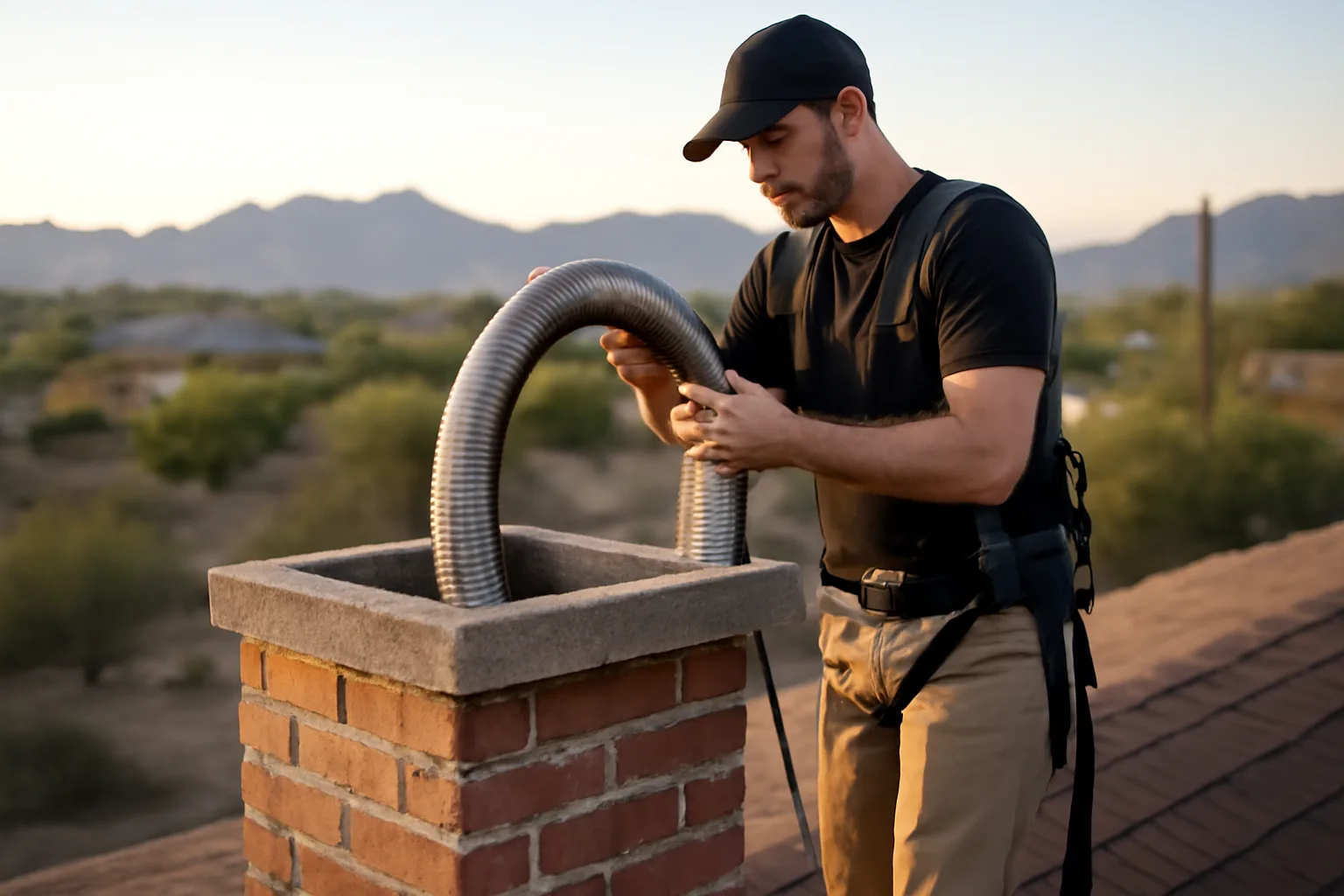
Flexible stainless steel systems (the kind most commonly used for relining gas or oil appliances) tend to run $1,200 to $2,500 installed on a standard two-story home. Rigid stainless sections cost a bit more in labor because each piece has to be aligned and secured. Cast-in-place liners, where a refractory material gets pumped into the flue to form a new liner, often run $2,000 to $4,500 or more depending on flue height and condition.
Arizona's climate adds a wrinkle some out-of-state cost guides miss. Extreme summer heat cycles stress liner materials over time, especially the sealants and connectors at the top and bottom of the flue. A properly spec'd Arizona liner should meet the temperature and corrosion resistance requirements in NFPA 211 [5], the standard for chimneys, fireplaces, vents, and solid fuel burning appliances. Ask any contractor which edition of NFPA 211 their liner system is rated to before you sign anything.
The table below gives typical Arizona installed cost ranges by liner type. These are market estimates built from national cost data adjusted for Arizona labor. Actual quotes vary by county, contractor, and current material prices.
| Liner Type | Typical Installed Cost (AZ) | Common Use |
|---|---|---|
| Flexible stainless (gas/oil) | $1,200, $2,500 | Relining existing masonry flues |
| Rigid stainless sections | $1,500, $3,000 | Straight or near-straight flues |
| Cast-in-place refractory | $2,000, $4,500+ | Deteriorated masonry, irregular flues |
| Aluminum flex (gas only) | $700, $1,400 | Low-temperature gas appliance venting |
Aluminum flex is the cheapest option and the most limited. It's rated only for gas appliances running at lower flue temperatures. Never put aluminum liner on a wood-burning fireplace or any solid-fuel appliance. That's not a preference. NFPA 211 prohibits it for those applications [5].
How long does chimney liner installation take in Arizona?
Most residential chimney liner jobs in Arizona take one to two days. A straightforward flexible stainless drop-in on a single-story home with good access can be done in three to five hours. Add a full masonry inspection, liner removal, and connector work and you're looking at a full day. Cast-in-place systems sometimes need a second visit after the refractory cures, which adds a day or more.
Permit processing is a separate clock. Arizona cities and counties vary on how fast they issue building permits for chimney work. Some jurisdictions require a permit for liner installation while others treat it as maintenance. Maricopa County and the City of Phoenix run their own building departments with their own timelines [6]. Call your local building department before you schedule the job. Starting work without a required permit creates problems when the home sells.
Contractor scheduling is usually the real bottleneck, especially October through December when homeowners suddenly remember their fireplaces exist right before the first cool nights. Want the work done before Thanksgiving? Call in September.
How do you get an ROC contractor license in Arizona?
The ROC application has several moving parts and none of them are fast. Here is the general path as the ROC describes it [1].
First, you or your designated qualifying party must pass a trade exam. The ROC contracts with Pearson VUE for exam scheduling. The qualifying party is the person whose experience and knowledge backs the license, and they need at least four years of journeyman-level experience in the trade they're applying for.
Second, you show proof of bonding and liability insurance. The bond amount depends on the license classification and the dollar volume of work you plan to do. General residential contractor bonds start around $200,000, but confirm current amounts with the ROC because these figures are set by statute and can change [1].
Third, you file the application with fees. ROC license fees vary by classification and sit on the ROC fee schedule. Pull that directly from the ROC website rather than trusting any third-party summary, this one included [1].
Fourth, the ROC reviews the application and may ask for more documentation. Processing times track application volume. The ROC does not publish a guaranteed window.
Still sorting out which classification your chimney liner business needs? That's the paper-path question ChimneyLinerPath's Liner vs Rebuild Kit at /start is built to help you think through. It does not replace a conversation with the ROC. It gives you a structured framework before you spend time on the phone.
Does Arizona require chimney liner inspections or permits?
Arizona has no statewide mandate that specifically requires a permit for chimney liner installation. That does not make permits optional everywhere. Local building departments in Phoenix, Tucson, Scottsdale, Mesa, and Chandler run their own codes and permit requirements, and many adopt local amendments to the International Residential Code (IRC) that can trigger a permit for chimney modifications [6].
The IRC itself, in Chapter 10 covering chimneys and fireplaces, sets minimum standards for liner materials and installation [7]. Arizona cities that have adopted the IRC (most have) inherit those standards by reference. A liner that fails IRC or NFPA 211 specs fails inspection, and the contractor has to redo the work.
The practical advice is simple. Call your local building department, give them the address, describe the scope (liner type, fuel type, any existing liner removal), and ask if a permit is required. Get the answer in writing by email if you can. Fifteen minutes now saves enormous headaches later.
Selling a house? Unpermitted chimney work that should have been permitted is a disclosure issue in Arizona. State disclosure law requires sellers to disclose known material defects, and an inspector flagging unpermitted liner work counts [8].
What liner materials are code-compliant in Arizona?
NFPA 211 is the primary reference standard for chimney liner materials in Arizona and across most of the country [5]. The standard says chimneys for solid-fuel appliances must be lined with materials rated for the temperatures and flue gases they produce. For wood-burning fireplaces and stoves, that usually means UL 1777-listed flexible or rigid stainless steel liner systems, or refractory clay tile liners in good condition.
For gas appliances running at Category I (non-positive pressure, flue gas temperatures above dew point), Type B double-wall gas vent or stainless steel liner listed to UL 441 works. High-efficiency condensing gas appliances produce acidic condensate, so they need a Category IV liner rated for positive pressure and wet conditions.
Arizona's dry climate is a mild advantage for clay tile compared to freeze-thaw states. Clay tile doesn't spall from freeze-thaw in Phoenix the way it does in Chicago. Even so, the thermal cycling from summer ambient heat (ground-level temps hitting 115°F or above) to winter fireplace use still stresses older tile work. A visual inspection before relining is always worth doing.
UL listing matters because the ROC and local building departments reference it during inspections. If your liner system doesn't carry a UL listing that matches its fuel type and appliance category, don't install it and expect it to pass [9][10].
How does Arizona compare to neighboring states on chimney liner licensing?
Arizona's ROC-based model looks a lot like what several western states use, but the specifics differ enough that you can't assume your Arizona license covers work across the state line.
California runs a Contractors State License Board (CSLB) with specialty classifications for masonry and related work. The CSLB is stricter on bonding and workers' compensation than the Arizona ROC. Full breakdown at chimney liner board in california.
Colorado has its own contractor licensing system, though local jurisdiction matters enormously there. Some Colorado counties have very little state-level oversight for specialty trades. Details at chimney liner board in colorado.
Expanding into multiple states? The licensing and bonding cost differences add up fast. The Arizona cost table above gives you Arizona-specific numbers. For multi-state comparisons, read each state guide on its own.
One thread runs through every western state here: none of them keep a dedicated chimney liner board separate from their general contractor authority. The trade-specific credentials (NFI, CSIA) stay voluntary everywhere in the region.
What should a homeowner look for when hiring a chimney liner contractor in Arizona?
Pull up the ROC license lookup tool and verify the contractor's license number before you sign anything [1]. The lookup is free, takes thirty seconds, and shows you whether the license is active, what classification it covers, and whether any complaints or disciplinary actions have been filed. Skip this step and you're taking a real risk.
Beyond the license, ask for their certificate of liability insurance and a copy of their bond documentation. Arizona requires both for licensed contractors, but paperwork lapses. A legitimate contractor hands these over without hesitation.
Ask which liner system they plan to install, the manufacturer's name, the UL listing number, and the gauge of the stainless steel. For wood-burning applications, 316L alloy stainless at 0.006-inch wall thickness is the minimum many installers recommend for longevity, though some systems use thicker gauge material and carry longer warranties. Get the warranty terms in writing.
Last, ask about the permit. If a contractor says permits aren't necessary for liner work without first checking with your local building department, that's a flag. They may be right. They may be trying to skip the permit process to save time. You own the house and the liability that comes with unpermitted work.
Where can you find ROC-licensed chimney contractors in Arizona?
The ROC's public license lookup lets you search by contractor name, license number, or license type and filter by city or county [1]. Start here, because it shows real-time license status.
The CSIA maintains a contractor locator where you can search for Certified Chimney Sweep professionals by ZIP code [3]. CSIA certification is voluntary, but contractors who have gone through it tend to be more invested in the trade.
The NFI website has a credentialed professional finder too [2]. NFI-certified technicians have passed written exams covering installation standards, venting codes, and appliance types.
Word of mouth still works in a state where fireplace use is seasonal and concentrated. Neighbors in mountain communities like Flagstaff, Prescott, or Sedona who actually run their fireplaces will have recent experience with local contractors. A Phoenix neighbor who lights a fire twice a year has less useful data.
Building your own chimney liner business in Arizona instead of hiring one? The licensing paper path at ChimneyLinerPath (/start) maps the ROC application steps alongside the insurance, bonding, and exam requirements so you're not piecing it together from scattered state PDFs.
For how neighboring states structure their contractor search and licensing, see chimney liner board in california and chimney liner board in colorado. For states with different regulatory models, chimney liner board in florida and chimney liner board in georgia are worth a read.
Frequently asked questions
Do you need a license for chimney liner work in Arizona?
Yes. Arizona Revised Statutes Title 32, Chapter 10 requires a Registrar of Contractors (ROC) license for chimney liner installation. There is no separate chimney-specific board. The ROC issues licenses by classification, and chimney liner work typically falls under a specialty or masonry contractor classification depending on the scope. Confirm your exact classification with the ROC before applying.
How much does chimney liner cost in Arizona?
Installed chimney liner costs in Arizona generally run $900 to $4,500. Flexible stainless steel systems for gas appliances average $1,200 to $2,500. Rigid stainless systems run $1,500 to $3,000. Cast-in-place refractory liners are the most expensive at $2,000 to $4,500 or more. Aluminum flex liner for low-temperature gas appliances is the cheapest at $700 to $1,400. Confirm current pricing with local contractors.
How long does chimney liner installation take in Arizona?
Most residential chimney liner jobs in Arizona take one to two days. A simple flexible liner drop-in on a single-story home with clear access can be finished in three to five hours. Cast-in-place systems may need a second visit after the refractory cures. Permit processing at the local building department adds time on top of the installation, so check with your city or county first.
Is there a separate chimney liner board in Arizona?
No. Arizona does not have a standalone chimney liner or chimney sweep licensing board. All contractor licensing, including chimney liner installation, is handled by the Arizona Registrar of Contractors (ROC). Voluntary professional credentials like the CSIA Certified Chimney Sweep or NFI certifications exist but are not required by state law.
What ROC license classification covers chimney liner installation in Arizona?
This depends on the scope of work. Chimney liner installation can fall under a C-41 Residential and Small Commercial classification or a masonry contractor classification if the work involves significant masonry repair. The ROC is the authoritative source here. Contact them directly to confirm which classification applies to your specific scope before submitting an application.
Does Arizona require a permit for chimney liner installation?
There is no statewide permit mandate specifically for chimney liner installation, but local building departments in Phoenix, Tucson, Mesa, Chandler, and other cities often require permits for chimney modifications under their local adoptions of the International Residential Code. Always call your local building department before starting work and ask whether a permit is required for the specific job you're doing.
What liner materials are allowed under Arizona code?
NFPA 211 is the primary standard. Wood-burning appliances require UL 1777-listed stainless steel liner or intact refractory clay tile. Gas appliances use Type B vent or UL 441-listed stainless liner for Category I appliances, or Category IV liner for high-efficiency condensing equipment. Aluminum flex liner is only permitted for low-temperature gas applications and is prohibited for solid-fuel appliances. Confirm UL listing numbers before purchasing any liner system.
Can a homeowner install their own chimney liner in Arizona without a contractor license?
Arizona's owner-builder exemption may let a homeowner install a chimney liner in their own primary residence without an ROC license, but the exemption has limits: you generally cannot hire unlicensed workers to perform the labor. The work still must meet local code and may require a permit. Review the ROC owner-builder guidance carefully before assuming the exemption covers your situation.
How do I verify a chimney contractor's ROC license in Arizona?
Use the free license lookup tool on the Arizona Registrar of Contractors website. Enter the contractor's name or license number to see whether the license is active, which classification it covers, and whether any complaints or disciplinary actions have been filed. Always check this before signing a contract. An active license doesn't guarantee quality, but it confirms the contractor meets Arizona's baseline legal requirement.
Does CSIA or NFI certification replace the ROC license in Arizona?
No. CSIA Certified Chimney Sweep and NFI professional credentials are voluntary industry certifications. Arizona does not accept either as a substitute for an ROC contractor license. They are complementary: the ROC license is the legal requirement to do business as a contractor, while CSIA and NFI credentials signal trade knowledge and professional standards to clients.
How do Arizona chimney liner licensing rules compare to California or Colorado?
All three states use a general contractor licensing authority rather than a dedicated chimney board: Arizona uses the ROC, California uses the CSLB, and Colorado relies on a mix of state and local licensing. California's CSLB has stricter workers' compensation and bonding requirements than Arizona's ROC. Colorado's requirements vary significantly by local jurisdiction. An Arizona ROC license does not authorize work in California or Colorado.
What happens if a contractor does chimney liner work in Arizona without an ROC license?
Under Arizona Revised Statutes section 32-1151, unlicensed contracting is prohibited and can result in civil penalties. Homeowners can file complaints with the ROC, which investigates and can order restitution or suspend future licensing eligibility. Unlicensed work also voids any ROC-backed surety bond protection the homeowner would otherwise have access to.
Are there Arizona-specific climate considerations for chimney liner selection?
Yes. Arizona's extreme summer heat creates thermal cycling stress even on flues that see little winter use. Stainless steel liner systems generally handle this better than deteriorated clay tile. Sealants and connectors at the top and bottom of the liner should be rated for high-temperature exposure. Ask your contractor which liner system they recommend specifically for Arizona's climate, and get that recommendation in writing.
Sources
- Arizona Registrar of Contractors, Licensing Overview and ARS Title 32 Chapter 10: Arizona requires an ROC license for contracting work including chimney liner installation; ARS 32-1151 prohibits contracting without a license
- National Fireplace Institute, NFI Certification Programs: NFI offers voluntary professional certification for chimney professionals including Chimney Sweep and Gas Appliance credentials
- Chimney Safety Institute of America, CSIA Certified Chimney Sweep Program: CSIA offers a Certified Chimney Sweep designation and maintains a contractor locator searchable by ZIP code
- U.S. Census Bureau, American Housing Survey: Baseline reference for residential construction cost data used to contextualize chimney liner installed cost ranges
- National Fire Protection Association, NFPA 211 Standard for Chimneys, Fireplaces, Vents, and Solid Fuel-Burning Appliances: NFPA 211 specifies liner material ratings, temperature requirements, and fuel-type restrictions including prohibition of aluminum liner for solid-fuel appliances
- City of Phoenix Planning and Development Department: Phoenix has its own building permit requirements that may apply to chimney liner installation under local IRC adoption
- International Residential Code 2021, Chapter 10 Chimneys and Fireplaces: IRC Chapter 10 specifies minimum standards for chimney liner materials and installation adopted by reference in many Arizona municipalities
- Arizona Department of Real Estate: Arizona real estate disclosure requirements require sellers to disclose known material defects including unpermitted construction work
- Underwriters Laboratories, UL Standards: UL 1777 is the listing standard for flexible and rigid stainless steel chimney liner systems used in wood-burning and solid-fuel applications
- Underwriters Laboratories, UL Standards: UL 441 is the listing standard for Type B gas vents and stainless steel liner systems used with Category I gas appliances