Last updated 2026-08-17
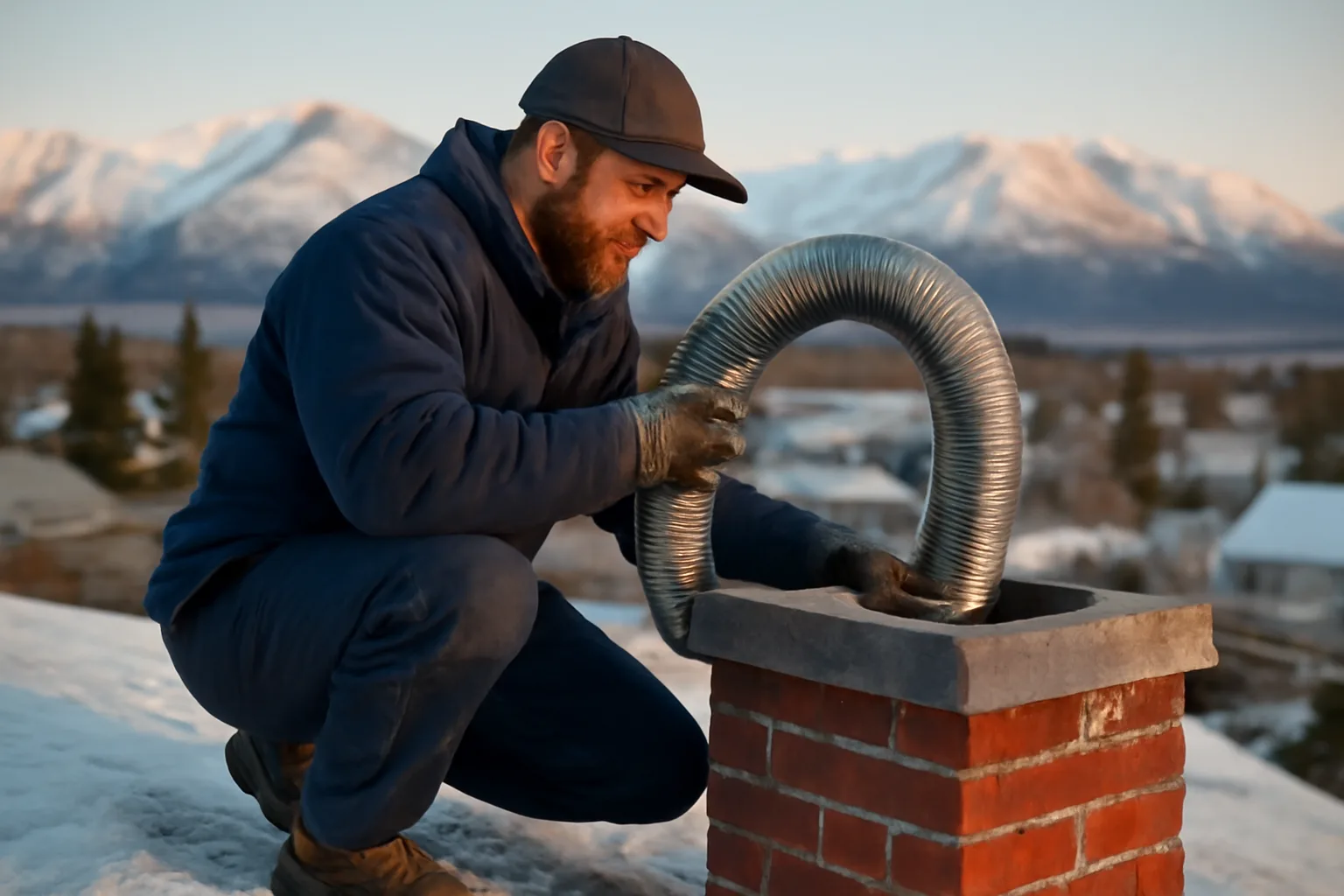
TL;DR
Alaska has no statewide chimney liner license. Most liner work falls under the general or specialty contractor system run by the Alaska Division of Corporations, Business and Professional Licensing. Local municipality permits are usually required in Anchorage, Fairbanks, and the Mat-Su Borough. Liner materials run $500 to $2,500 or more depending on flue size and type. Installation usually takes one to two days.
Do you need a license for chimney liner work in Alaska?
Alaska issues no chimney-specific or chimney liner-specific license at the state level. The state's contractor licensing framework, run by the Alaska Division of Corporations, Business and Professional Licensing (DCCED), covers general and specialty contractors but carves out no distinct chimney liner trade the way some states do for HVAC or electrical work [1].
That does not mean you can show up and start lining flues with no credentials. If you charge customers for the work, Alaska requires you to hold an appropriate contractor license, and liner installation almost always falls under that umbrella. The two relevant tiers are General Contractor and Mechanical/Specialty Contractor, and which one you need depends on your scope of work. Confirm the current tier requirements with the DCCED licensing office before you apply, because scope definitions have shifted in recent years.
Some liner jobs also touch the gas or oil appliance connection, which pulls in Alaska's mechanical contractor rules. If you are relining a flue that serves a gas appliance, the connection side of the job may require a separate mechanical contractor license or a licensed plumber or gasfitter working alongside you. The Division publishes its current license categories and fees online [1].
No chimney liner license exists in Alaska. A general or specialty contractor license almost certainly applies to you if you plan to do this work for pay. Get that sorted before you quote a single job.
What contractor license do you actually need in Alaska?
Alaska's contractor licensing statute is AS 08.18, which requires any person who contracts for construction work to hold a valid contractor license [2]. The statute defines 'contractor' broadly, and specialty trades are included when they perform discrete improvement work on a structure.
For chimney liner installation, the most common fit is the Specialty Contractor license, usually the category covering insulation and weatherproofing, or sometimes an HVAC-related category. The General Contractor license covers everything but costs more in bonding. Here is a quick comparison of what each tier typically involves, based on current DCCED guidance. Confirm fees and bond amounts before applying, because these change.
| License Type | Typical Use Case | Bond Requirement (verify with DCCED) |
|---|---|---|
| Residential General Contractor | Full remodel scope including liner | Higher bond, broader scope |
| Specialty Contractor | Single-trade liner installs | Lower bond, narrower scope |
| Mechanical Contractor | Gas appliance/venting work | Separate exam often required |
The exam requirement for specialty contractors has historically been minimal compared to states like California or Arizona, but DCCED updates requirements periodically. Check the current application packet at the DCCED website rather than relying on what someone told you two years ago.
Working across municipal boundaries adds another layer. Anchorage, Fairbanks, and the Matanuska-Susitna Borough all run their own building departments that issue permits separately from the state license. A state license is necessary but not always sufficient.
Do Anchorage and other Alaska municipalities have separate chimney liner rules?
Yes, and this is where most people get tripped up. The Municipality of Anchorage runs its own building code and requires permits for chimney liner installations under the International Residential Code (IRC) as locally adopted [3]. The Fairbanks North Star Borough and the City of Fairbanks each run their own building departments with similar requirements.
In Anchorage, a building permit for a chimney liner replacement or new liner installation typically falls under the mechanical permit category. The permit fee is based on the job valuation. You apply through the Anchorage Development Services Division. Inspections are required, and the work must meet IRC Chapter 10 (chimneys and fireplaces) and Chapter 8 (venting) as adopted locally [10].
Fairbanks follows a similar model. The Fairbanks North Star Borough Planning Department handles permits for areas outside the city limits, while the City of Fairbanks has its own building official. Rural Alaska municipalities, or areas under second or third class borough jurisdiction, may have no local permit requirement at all. Federal building standards still apply if the work touches HUD-regulated housing or tribal housing units.
Call the local building department for every job location before you schedule. Ask specifically whether a mechanical or building permit is required for chimney liner replacement. This call takes five minutes and can save you a stop-work order.
How much does chimney liner cost in Alaska?
Material costs for a stainless steel flexible liner system run roughly $500 to $1,800 for the liner itself, depending on diameter and length [5]. A 6-inch liner for a typical single-story wood stove costs less than an 8-inch liner for a multi-story oil boiler. Rigid liner sections cost more per linear foot but sometimes get specified for straight, short flue runs.
Installation labor in Alaska sits noticeably higher than the Lower 48. Supply chain costs, the shortage of trained chimney specialists in rural areas, and the general premium on skilled labor statewide all push the number up. Expect total installed costs (materials plus labor) to range from about $1,200 to $4,000 or more for a standard residential job in Anchorage or Fairbanks. Rural jobs run higher once you add travel, freight, and lodging for the installer.
Cast-in-place liner systems, which use a poured refractory material to form a new flue inside the existing masonry, sit at the top of the range. These are marketed for deteriorated masonry chimneys and can run $2,500 to $6,000 or more depending on flue length and access. Nobody has good public data on Alaska-specific chimney liner pricing. The figures above come from Angi's 2023 national cost estimate combined with Alaska's documented labor and freight premium over national averages [5].
Permit fees in Anchorage are calculated on job valuation and typically add $50 to $200 to a standard liner job. Confirm the current fee schedule with the Anchorage Development Services Division before quoting.
For a breakdown of material types by estimated cost, see the chart below.
How long does chimney liner installation take in Alaska?
A standard flexible stainless steel liner installation takes one to two days for a single-flue residential chimney. That time covers removing the old liner or preparing the existing flue, dropping the new liner from the top, connecting it at the appliance end, and installing a proper top plate and rain cap.
Cast-in-place systems take longer. The inflation and pour process for a refractory liner usually takes one day, but the material must cure before the appliance can be fired. Cure times vary by product, typically 24 to 72 hours before the first low-heat seasoning fire, and longer before full-load use. Confirm cure requirements with the specific product's technical sheet.
Alaska adds timing wrinkles the Lower 48 does not. Permit approval in Anchorage currently averages several business days for a mechanical permit, and the city's online portal shows current processing times, which shift seasonally. Winter scheduling is real. Chimney liner work in January in Fairbanks at minus 30 degrees is miserable, and some installers refuse rooftop work below certain temperatures because of ice and safety risk. Plan your jobs for late spring through early fall if you have any flexibility.
For a new business, the permit-to-completion timeline for a first job often runs two to three weeks once you factor in licensing confirmation, permit application, scheduling, installation, and inspection. Contractors who have standing relationships with local building departments move faster.
What bonding and insurance does Alaska require for chimney liner contractors?
Alaska's contractor licensing statute requires a surety bond as a condition of licensure [2]. The bond amount depends on license category and has changed over the legislative sessions, so verify the current requirement directly with DCCED. Specialty contractors have historically carried bonds in the $5,000 to $20,000 range, but that is not a figure to rely on without confirming.
General liability insurance is not mandated by state statute the same way bonding is, but no commercial customer, no property management company, and no municipality is going to hire an uninsured chimney contractor. Carry at minimum $500,000 in general liability coverage. Most commercial jobs will ask for $1,000,000. Workers' compensation is required if you have any employees under Alaska Statute 23.30 [6].
If you are a one-person operation doing owner-occupied residential work only, the insurance math is simpler, but it does not disappear. A chimney liner that fails and causes a house fire is a catastrophic liability claim. Get the insurance before the first job, not after something goes wrong.
What codes govern chimney liner work in Alaska?
Alaska adopts building codes at the state level through the Department of Labor and Workforce Development for certain occupancy types, and municipalities adopt codes independently for residential construction. The International Residential Code (IRC), 2018 edition or a locally amended version, is the baseline for most residential chimney liner work in major Alaska municipalities [10].
IRC Section R1003 covers masonry chimneys. Section R1004 covers factory-built chimneys. Section G2427 covers venting of appliances. The Chimney Safety Institute of America (CSIA) standards and the National Fire Protection Association's NFPA 211 (Standard for Chimneys, Fireplaces, Vents, and Solid Fuel-Burning Appliances) are referenced by inspectors and set the technical baseline for liner sizing, clearances, and material specifications [4]. NFPA describes the document's scope this way: it covers "the location, installation, design, construction, and maintenance of chimneys, fireplaces, venting systems, and solid fuel-burning appliances."
NFPA 211 runs on a three-year cycle. The 2024 edition is the current version. It includes provisions for relining deteriorated masonry chimneys, sizing requirements based on appliance type and BTU output, and material standards for stainless steel liner alloys (typically 304 or 316L stainless, with 316L recommended for oil appliances because of its sulfur resistance).
Alaska's rural housing stock includes many homes with non-standard or aging chimneys that predate modern code. Plenty of those installations were never permitted. If you are working on a pre-existing flue with no documentation, treat it as unknown condition and inspect before you quote.
How do you actually start: the step-by-step paper path for Alaska
Here is the real sequence for someone starting a chimney liner business in Alaska, not the generic 'consult a professional' brush-off.
Step 1: Determine your business structure. File with the Alaska Division of Corporations as a sole proprietor, LLC, or corporation. An LLC provides liability separation and costs around $250 to form as of recent years. Confirm the current fee with the Division of Corporations before you file [8].
Step 2: Get your Employer Identification Number (EIN) from the IRS if you operate as anything other than a sole proprietor under your own SSN. It is free and takes minutes online [9].
Step 3: Apply for your Alaska contractor license through DCCED. Gather the bond, proof of insurance, and application fee. Processing times vary. The DCCED office has historically taken two to six weeks for specialty contractor applications, but confirm the current processing time when you apply.
Step 4: Register for Alaska business tax accounts if applicable. Alaska has no state income tax and no state sales tax, but some municipalities (including Anchorage) have a local sales tax. Fairbanks has one too. Know your local tax obligations.
Step 5: Set up your supply accounts with liner distributors. Flex-liner systems are available from national distributors like Olympia Chimney Supply and others. Confirm freight costs to your Alaska location before pricing jobs, because freight to Anchorage from the Lower 48 adds real cost.
Step 6: Pull permits for each job. Do not skip this step. An unpermitted liner becomes a liability when the property sells or when an insurance claim comes in.
For anyone working through this process and trying to organize the licensing paperwork, the Liner vs Rebuild Kit at ChimneyLinerPath is a one-time purchase built to give you the document checklist and decision tree for exactly this kind of licensing and job-scoping work.
How does Alaska compare to neighboring states for chimney liner licensing?
Alaska sits on the lighter end of the regulatory spectrum for chimney liner work, at least at the state level. No dedicated chimney contractor license exists, which lowers the barrier to entry compared to states with trade-specific requirements.
For comparison, how to start chimney liner in Arizona and how to start chimney liner in California involve more layered state licensing structures for this kind of specialty work. Alaska's approach sits closer to how to start chimney liner in Arkansas, where the general contractor framework handles liner work without a trade-specific credential.
The tradeoff is that lighter state regulation puts more weight on local municipal rules, and Alaska's municipal patchwork is significant. Anchorage, Fairbanks, and the Mat-Su Borough each operate independently. In rural areas, building oversight may be minimal or nonexistent, but that does not mean federal code compliance disappears, especially for tribal or HUD-assisted housing.
If you are weighing operations in multiple states, the chimney liner license in Alaska page goes deeper on the specific license categories and fees without the startup context.
What professional certifications actually matter for Alaska chimney liner work?
Alaska requires no chimney-specific certifications from the state, but two industry credentials carry real weight with customers and inspectors.
The Chimney Safety Institute of America (CSIA) offers the Certified Chimney Sweep (CCS) credential. It requires passing a written exam based on NFPA 211 and industry standards [7]. The CSIA also offers a Certified Dryer Exhaust Technician credential. These are not cheap to earn (exam fees, study materials, and continuing education add up), but they set you apart in a market where customers have no state-issued credential to evaluate.
The National Fireplace Institute (NFI) offers certifications for gas, wood, and pellet appliance installation. If you are relining flues that serve gas appliances, an NFI Gas Specialist credential shows you understand appliance-venting interaction, which matters to customers and to inspectors reviewing your permit work.
Neither CSIA nor NFI certification is mandatory in Alaska. In the absence of a state licensing exam that proves competence, these credentials are the closest thing the market has. Customers researching chimney liner contractors in Anchorage or Fairbanks will find very few who hold them, which means holding one puts you on a short list fast.
What are the biggest startup mistakes to avoid in Alaska chimney liner?
The most common mistake is treating the absence of a chimney-specific license as the absence of any licensing requirement. It is not. Operating as an unlicensed contractor in Alaska violates AS 08.18 and can result in fines, civil liability, and the inability to collect on contracts [2].
The second big mistake is pricing jobs without accounting for Alaska's freight premium on materials. A 25-foot flex liner kit that ships cheaply within the continental US can cost $100 to $300 more in freight to Anchorage. Rural Alaska is worse. Build this into your quotes.
Third: skipping permits to move faster. An unpermitted liner creates problems at resale, voids some manufacturer warranties, and leaves you exposed if the appliance causes a fire and the insurer investigates whether the installation was code-compliant.
Fourth: ignoring the cold-weather operational limits of the liner systems you install. Flexible stainless liner stays flexible in cold weather, but the insulation wrap (used on oversized flues to reduce the effective diameter and improve draft) can perform differently at extreme Alaska temperatures. Read the product technical documentation.
Fifth: underestimating the geographic scatter of the market. Alaska is enormous. If you are based in Anchorage, jobs in the Kenai Peninsula or Mat-Su Valley mean real travel time. Price that in or restrict your service area until your volume supports the drive.
For a detailed look at what the licensing paperwork looks like, the chimney liner license in Alaska guide breaks down every document you need for the DCCED application. ChimneyLinerPath also publishes state comparison guides for nearby markets like how to start chimney liner in Colorado if you are planning multi-state operations.
Frequently asked questions
Do you need a license for chimney liner work in Alaska?
Alaska has no chimney liner-specific license. Anyone charging customers for chimney liner installation almost certainly needs a General or Specialty Contractor license under AS 08.18, administered by the Alaska Division of Corporations, Business and Professional Licensing. Gas appliance connections may also require a mechanical contractor license. Local municipality permits are required in Anchorage, Fairbanks, and the Mat-Su Borough regardless of state licensing.
How much does chimney liner cost in Alaska?
Stainless steel flexible liner materials cost roughly $500 to $1,800 depending on diameter and length. Total installed cost, including labor, runs about $1,200 to $4,000 for a standard residential job in Anchorage or Fairbanks. Rural Alaska jobs cost more because of freight and travel. Cast-in-place refractory liner systems can run $2,500 to $6,000 or higher. Permit fees in Anchorage typically add $50 to $200.
How long does chimney liner installation take in Alaska?
A standard flexible stainless liner installation takes one to two days. Cast-in-place refractory systems take one day to install but require 24 to 72 hours of cure time before first use. Factor in permit processing, which in Anchorage averages several business days. Winter scheduling in Fairbanks can push timelines further. First-job total timelines from permit application to final inspection often run two to three weeks.
Does Alaska have a state chimney contractor license?
No. Alaska issues no chimney contractor or chimney sweep license at the state level. Chimney liner work falls under the general or specialty contractor licensing framework administered by the Alaska DCCED. This is lighter regulation than states like California or Arizona, but the contractor license requirement is real and enforceable under AS 08.18.
What building code applies to chimney liner work in Alaska?
Most Alaska municipalities with active building departments follow the International Residential Code, usually the 2018 edition or a local amendment. IRC Chapter R1003 covers masonry chimneys and liner requirements. NFPA 211 (2024 edition) is the national technical standard for chimney liner sizing and materials. Local adoption varies, so confirm with your specific municipality's building department before starting work.
Are permits required for chimney liner installation in Anchorage?
Yes. The Municipality of Anchorage requires a mechanical permit for chimney liner replacement or new liner installation. Applications go through the Anchorage Development Services Division. Fees are based on job valuation. Inspections are required. Skipping the permit creates liability at resale and may void manufacturer warranties. Call the building department before you schedule the job.
What insurance does an Alaska chimney liner contractor need?
Alaska requires a surety bond as part of contractor licensing. General liability insurance is not explicitly mandated by state statute but is required by virtually every commercial client and is essential given chimney fire liability. Minimum $500,000 in general liability is standard; $1,000,000 is common for commercial work. Workers' compensation is required for any employees under Alaska Statute 23.30.
Can I do chimney liner work in rural Alaska without a permit?
In some second and third class borough areas without local building departments, no municipal permit is required. AS 08.18 contractor licensing still applies if you are paid for the work. Federal standards also apply to tribal and HUD-assisted housing regardless of local permit requirements. Never assume 'no local permit needed' means 'no rules apply.' Confirm with the borough or borough equivalent for each job location.
What stainless steel grade should Alaska chimney liner use?
NFPA 211 distinguishes between 304 and 316L stainless for liner applications. For wood-burning appliances, 304 is generally acceptable. For oil or coal appliances, 316L is recommended because of its higher resistance to sulfur-bearing condensates. In Alaska's cold climate, condensation in oversized or underinsulated flues is a real concern, which makes liner sizing and insulation wrap selection more consequential than in warmer climates.
How do I find chimney liner supply distributors in Alaska?
Most chimney liner systems ship from Lower 48 distributors. Olympia Chimney Supply and similar national distributors ship to Alaska, but freight costs to Anchorage or beyond add real money. Some building supply stores in Anchorage stock basic liner components. For rural jobs, plan freight timing carefully and factor shipping into job quotes from the start. Order lead times to remote Alaska locations can run one to two weeks.
Does CSIA certification help in Alaska?
Yes, practically. Alaska has no state licensing exam that demonstrates chimney competence, so the Chimney Safety Institute of America's Certified Chimney Sweep credential is the closest thing the market has to a verified standard. Very few Alaska contractors hold it. Customers and inspectors familiar with the credential recognize it. It is not legally required, but it sets you apart in a small, word-of-mouth-driven market.
How long does Alaska contractor license processing take?
The Alaska DCCED has historically taken two to six weeks to process specialty contractor license applications, though times fluctuate. Do not rely on this range. Call DCCED or check the online application portal for current processing times before planning your launch date. Submitting an incomplete application restarts the clock, so assemble all bond and insurance documentation before you apply.
What is the biggest cost difference between Alaska and Lower 48 states for chimney liner work?
Labor costs run higher in Alaska than national averages, and freight on materials is a significant added cost that does not exist in the continental US. A liner kit that costs $800 in materials in the Lower 48 might cost $1,000 to $1,100 delivered to Anchorage, and more to rural locations. Alaska's general cost of living premium also shapes what customers expect to pay, which offsets some of the cost.
Sources
- Alaska DCCED, Division of Corporations, Business and Professional Licensing, Construction Contractors: Alaska DCCED administers contractor licensing and does not list a chimney liner-specific license category
- Alaska Statutes AS 08.18, Contractors, Licensing Requirements: AS 08.18 requires any person contracting for construction work in Alaska to hold a valid contractor license
- Municipality of Anchorage, Development Services Division: Anchorage requires mechanical permits for chimney liner installations under the locally adopted IRC
- NFPA 211, Standard for Chimneys, Fireplaces, Vents, and Solid Fuel-Burning Appliances: NFPA 211 sets technical standards for chimney liner materials, sizing, and installation requirements
- Angi, Chimney Liner Cost Guide 2023: National chimney liner cost estimates range from approximately $500 to $2,500+ for materials and $1,200 to $4,000 installed
- Alaska Statutes AS 23.30, Alaska Workers' Compensation Act: AS 23.30 requires Alaska employers to carry workers' compensation insurance for employees
- Chimney Safety Institute of America (CSIA): CSIA offers the Certified Chimney Sweep credential based on NFPA 211 and industry standards
- Alaska Division of Corporations, Business and Professional Licensing, Corporations Section: Alaska LLC formation and business license fees are set by the Division of Corporations
- IRS, Apply for an Employer Identification Number (EIN) Online: EIN applications are free and processed online through the IRS
- International Code Council, International Residential Code 2018, Chapter 10 Chimneys and Fireplaces: IRC Chapter 10 Section R1003 governs masonry chimney liner requirements in jurisdictions adopting the 2018 IRC